

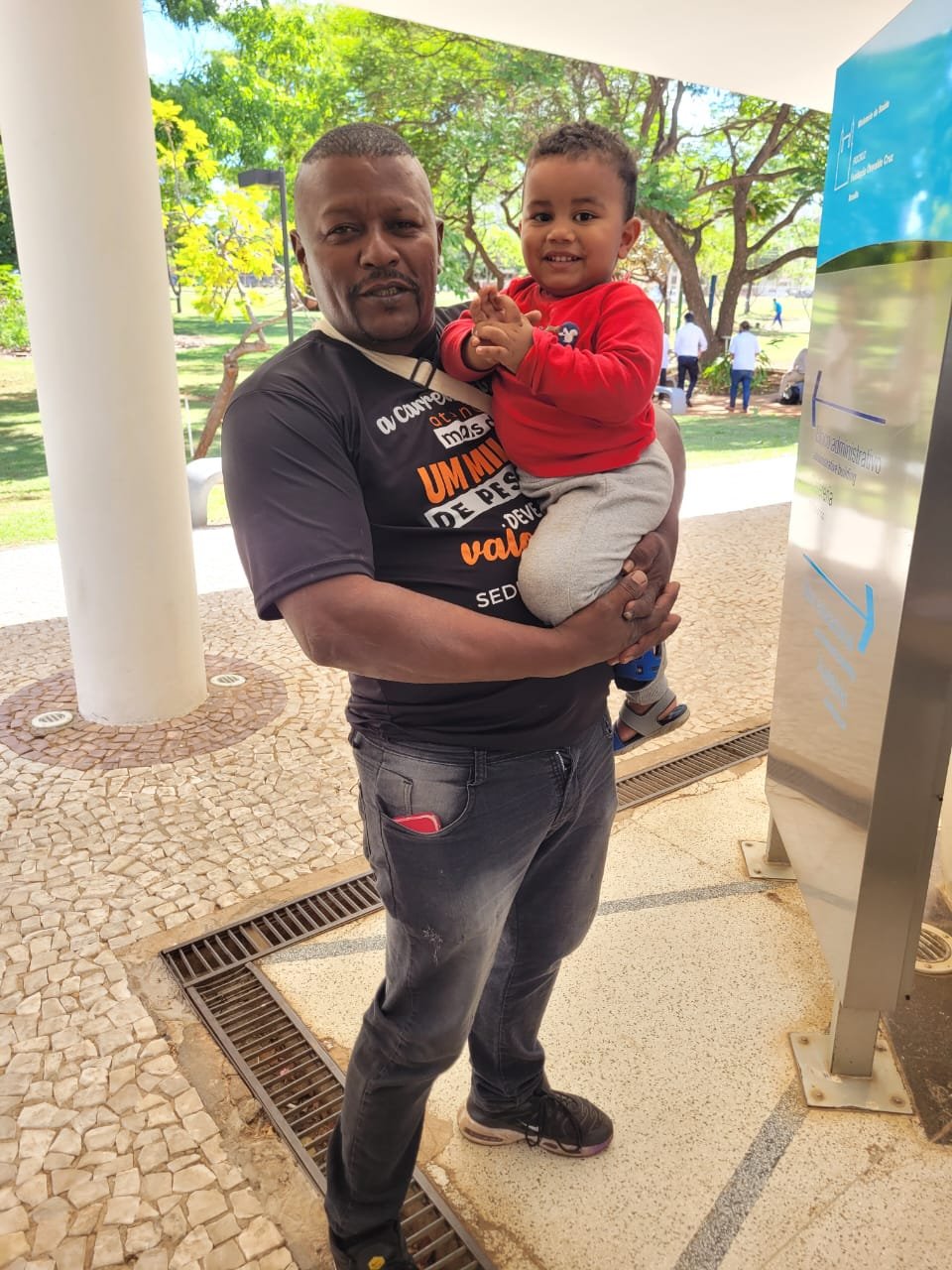
“My name is Kleidson Oliveira Beserra. I spent almost six years on the streets, from 2005 to 2011.” The presentation seems simple, but it carries a profound twist: for a long time, he wasn't even called by his name. “I was only called Radiola. Radiola was an insignificant guy. Not Kleidson.” The pejorative nickname came from a deficiency in his arm, which, due to its positioning, resembled the arm of a record player.
The street, he says, teaches. It teaches hardness. It teaches fear. But it also reveals gestures of unexpected humanity. “People who can't afford anything are empathetic. They offer more than they have.”
For almost six years, Kleidson lived between pavements, marquees and imposed silences. From the street, he brought marks, but also the idea that solidarity is born where you least expect it. In this conversation, he reconstructs his journey in his own voice; from shame to welcome, from the nickname he didn't choose to regaining his name.
The street and what it taught us
“Nobody chooses to live on the street,” he says. “But a series of wrong choices can lead you to rock bottom.” During his time on the streets, he learnt to distinguish between two types of help: that which comes from the heart and that which comes with interest. “There's industrialised solidarity, which goes out into the street expecting a return. This dissipates public policy.”
Through her experience, she realised that listening is the true transformative resource. “The people who help the most are those who listen well.”
The stigma and the recovered name
Even though he needed care, he avoided going to the Psychosocial Care Centre (CAPS) in his neighbourhood: he was afraid of the label. “They said it was a place for crazy people, drug addicts.” She sought care away from home and found the opposite of the stigma: welcome. “I didn't use any substances for 30 days. That gave me strength.”
From then on, he began to replace addiction with something else: “freedom”.
The meeting that turned into a new beginning
In the midst of his helplessness, he also met his partner, Brenda, a young woman marked by violence and hopelessness. “I was slowly committing suicide. So was she.” The relationship emerged as a mutual survival pact. “Looking after someone was the best thing that ever happened to me.”
The two became stronger on the street and decided together to leave it. “I didn't want her to go through what I went through. I decided to give her a roof over her head.”
Today, life includes children and a routine that smells of belonging. “I walk around smelling nice, tidy and clean. I have an identity. I'm a reference.”
Kleidson is currently the organiser of the PopRua National School, an initiative of the Centre for Populations in Situations of Vulnerability and Mental Health in Primary Care (NUPOP/Fiocruz).
When care works
The welcome he experienced in mental health marked his perception of change. “The individual has to want it. There is no miracle. But the support network sustains the process.” The decision to leave required strong reasons. “One of the important factors was family. Another was to protect someone.”
The CAPS discussion groups also left an impression. “There's always someone defending the SUS, defending the Psychosocial Care Network (RAPS). It's exciting because it recognises professionals who really help.”
Other memories that can't be lost
Among the most memorable episodes, Kleidson recalls the day he saved a little girl from drowning in Espírito Santo. “I held her by the chest and felt her heart beating fast and hard.” He thinks about her to this day, imagining who she might have become.
Why public policies fail
Kleidson has a precise diagnosis of PopRua's policy: it lacks continuity, listening and the presence of those who have lived on the streets. “They give the guy a packed lunch and leave him alone. There's no follow-up.” The problem, he says, is exacerbated when third-party organisations operate without the participation of graduates. “They hire outsiders who have no empathy. The policy isn't effective.”
From this experience, he created, with his wife and other companions, the Instituto Pop Rua Brasil. “The first institution created by people born on the street. Everything came from experience. Now we have to wait for the CNPJ to start operating.”
What's next?
“Today I see things more clearly than before,” she says. Looking at her own children (three), she rediscovers reasons to carry on. “I wake up, kiss my little one (Mateus, pictured with him). Life is very good.”
The struggle is now collective: the defence of the rights of the homeless population and the strengthening of complete, not fragmented, policies. “We continue. We don't give up.”
Ethical note
This report is based entirely on the testimony given by Kleidson Oliveira. O Solidaritas adopts practices of qualified listening, respect for narrative autonomy and an explicit commitment not to reproduce stigmas associated with the homeless population.