

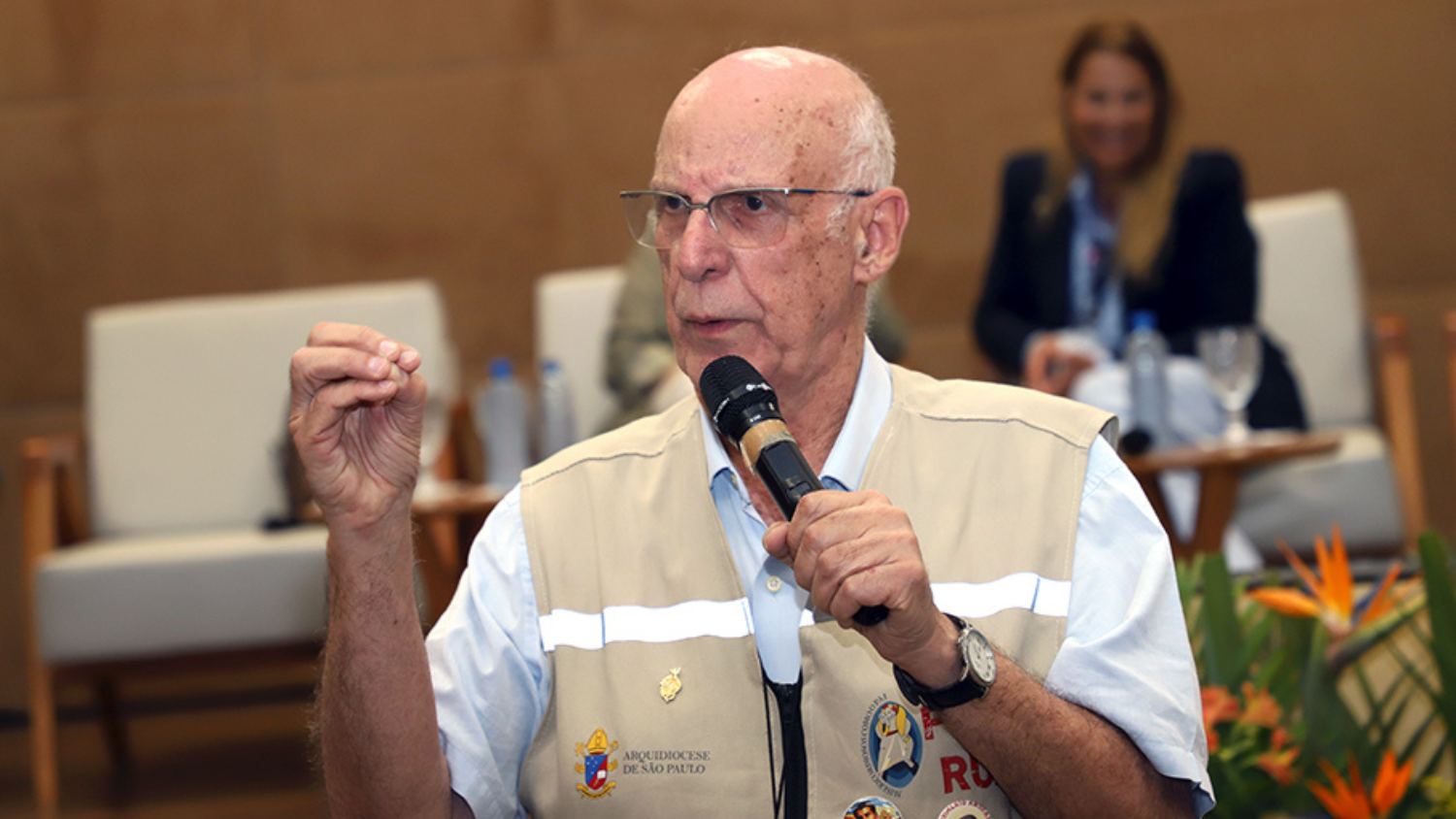
At the International Seminar on Street People: Comprehensive Care and Rights Now, held at Fiocruz Brasilia, the tone was one of confrontation, self-criticism and ethical repositioning in the face of the extreme suffering imposed on homeless people in Brazil. Father Júlio Lancellotti, from the Pastoral do Povo da Rua in São Paulo, expressed the mood of the meeting: no celebration, but denunciation. He rejected the symbolic distance of the pulpit, preferring to “speak from below”, and drew attention to power structures that naturalise misery, crystallise harmless institutional practices and subject workers and organisations to a neoliberal logic that treats public policy as a mechanism for maintaining poverty.
His intervention openly confronted the capture of agents and institutions by the logic of capital, property speculation and agribusiness; he criticised “mummified” projects that serve power and not people; and he evoked the ethical duty to resist, propose and disobey when necessary. The denunciation is blunt: while capital is sacralised, the poor are sacrificed. For Lancellotti, the central question is: who are we serving?
He advocated insurgent and community practices that put life, not targets, reports or funding, at the centre of action.
At the end of his speech, Lancellotti gave the floor to Rafael Machado, a trans person, national coordinator of the Street People's Movement in Alagoas and counsellor on the National Councils for Social Assistance and Justice. Rafael questioned the absence of trans people and other LGBTQIAPN+ identities in the programming and design of care policies aimed at the homeless population. His intervention was direct: how can we talk about comprehensive care when the LGBT agenda, especially the trans agenda, continues to be invisibilised?
Rafael recalled that the phenomenon of the LGBTQIAPN+ homeless population is growing, facing successive violations, high mortality, exclusion and abandonment. The central criticism falls on a field of care structured primarily on the basis of the cisgender matrix, ignoring the specific demands, including health, of those who need to transition without specialised support. The speech highlighted the risks of self-administered hormone therapy due to the lack of endocrinologists, qualified care and reception in the SUS: risk of thrombosis, heart attacks, general lack of assistance.
Rafael recounted his journey: 14 years living on the streets, survivor of seven attempted murders, and today, about to graduate in Social Work thanks to public policies that, in his words, “changed my life”. An adoptive mother (her son is six months old), she emphasised that there are specific needs that are not covered: if she doesn't menstruate, she still faces real needs for comprehensive healthcare and institutional recognition.
The criticism has spread to the labour market, which remains exclusionary: while there is talk of mortality among cis men and women, the trans population remains marginalised, pushed into prostitution, exposed to extreme violence and criminalisation.
Recalling the maxim “nothing about us without us”, Rafael insisted on effective representation at debate tables and in politics, and recounted the movement's experiences of inclusion - such as the annual action that takes more than 300 homeless people to a water park in Alagoas, not just for leisure, but as a political gesture of belonging and dignity.
Finally, he affirmed his willingness to “cause”, because cause (causing dislocation and discomfort) is part of the struggle. “I don't fight to win; I fight to be faithful to the end.”
His presence at this seminar, he said, is a living mark of LGBTQIAPN+ resistance on the streets and in politics.
Read more
Coverage of 22 October 2025
- International round table: What kind of world is this? Realities and possibilities of transformation for the social protection of the homeless population
- Panel I : We are not invisible: information for public policies
- Panel II : Homeless women: comprehensive care, maternity and social protection from the perspective of gender and race equality
- Trilhas invites: Fr Julio Lancellotti
Panel III:The right to social protection and health care in Brazil.