

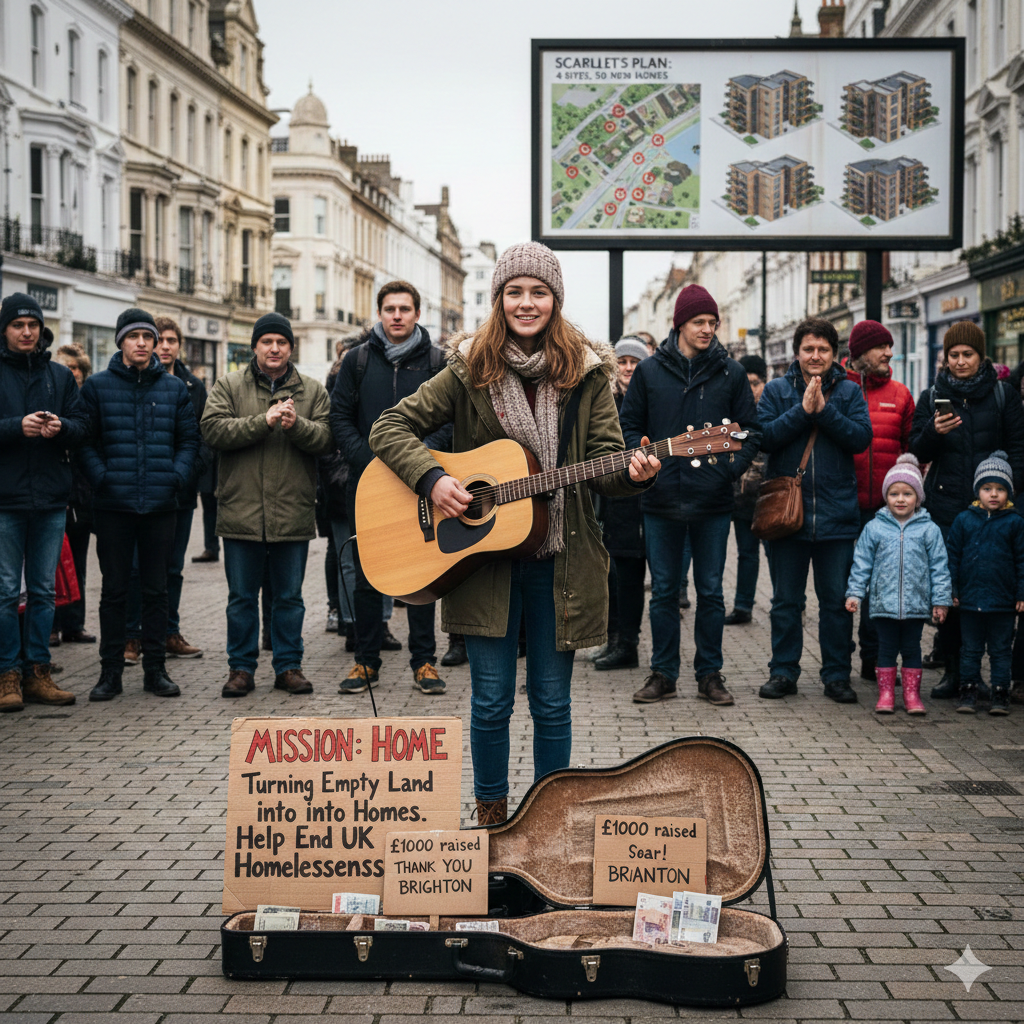
Amid record growth in the number of families living in temporary accommodation in the UK, a campaign led by a 15-year-old teenager has caught the attention of local authorities and public opinion. The initiative, created by Hove resident Scarlett Chapman, seeks to put pressure on the public authorities to identify under-utilised land and turn it into permanent housing for homeless families. The movement stems from a simple but uncomfortable realisation: the housing crisis is not just due to a lack of resources, but also to the inefficient use of urban land. .
According to the report, local councils across the UK are facing increasing difficulties in coping with the rise in the number of families living in hotels, shelters or other forms of temporary accommodation. These arrangements, thought of as emergency solutions, have become permanent for thousands of people, especially families with children. It is in this context that Scarlett is launching the Mission: HOME, with the aim of mapping small plots of idle public land - known as microsites - capable of receiving new housing developments.
The campaign started on a local scale in Brighton and Hove, but quickly gained visibility. The first step was to identify four plots of land belonging to the city council that could be used for new housing. The strategy is based on the idea that instead of looking for large areas - which are often scarce or expensive - it is possible to expand the housing supply from smaller spaces distributed around the city. For Scarlett, this approach is not only more viable, but also helps to integrate new housing into the existing urban fabric, avoiding the concentration of poverty.
The teenager's path to social activism is not linear, but it reveals an early commitment. Before founding Mission: HOME, Scarlett was already writing opinion pieces about the housing crisis in Brighton and Hove. Over time, she realised that writing wasn't enough. She decided to turn her indignation into organised action. When she changed schools, she devoted herself more intensely to the campaign, getting involved in mobilisation and fundraising.
One of the milestones of this phase was the initiative to sing on the streets to raise funds. The strategy yielded around £1,000 (around £7,000), which was donated to institutions that work with homeless people. More than the amount raised, the action had a symbolic effect: it drew attention to the problem and brought the campaign closer to real stories. Scarlett reports talking to a mother living in temporary accommodation, who told her how her 15-year-old son had dropped out of school to look after his younger siblings and his own mother. The story reinforced the realisation that the lack of adequate housing has cascading effects, affecting education, health and future prospects.
The figures help us to realise just how serious the local situation is. In Brighton and Hove, in the south-east of England, around 3,580 people currently live without stable housing, which is equivalent to one in every 77 people. The city ranks 19th in the ranking English people sleeping on the streets, with a rate of 30 per 100,000 inhabitants, according to data cited in the material. These indicators put additional pressure on public services and expose the limits of policies based exclusively on temporary solutions.
The campaign led by Scarlett is not limited to denunciation. One of the central themes is citizen participation in urban planning. The teenager has been encouraging residents to express their support for the project before it is formally submitted to the city council, scheduled for February. The idea is to demonstrate that there is social support for initiatives that expand the supply of social housing, even on a small scale. For her, the housing crisis requires a change of mentality: to see planning as a collective and continuous process, rather than an emergency response to peaks in demand.
Scarlett sees her initiative as a starting point, not a definitive solution. In her words, it's the “first step” in a journey that needs to be taken on by society as a whole. She hopes that by making the debate more accessible and concrete, the campaign can inspire similar projects in other cities across the country. The expectation is that the microsites spread, gradually expanding the response capacity of municipalities.
Alongside her activism, the young woman maintains typical teenage interests. She dreams of a career in music and has already released songs on platforms such as Spotify. Even so, she recognises the tension between the desire to be on stage and the awareness that her voice, outside of it, can have a relevant social impact. For Scarlett, both paths intersect: using visibility - whether as a singer or activist - to raise awareness about the housing crisis.
The case illustrates how the housing crisis in the UK has produced new forms of engagement, including among young people. By shifting the debate from the abstract field of statistics to concrete proposals for the use of urban space, the campaign Mission: HOME reveals both the depth of the problem and the transformative potential of local action. In a scenario of pressurised public policies and scarce solutions, the initiative of a teenager raises an uncomfortable question: if even students can identify viable ways forward, what is missing for them to be adopted on a large scale by public authorities?
Source: Meet the 15-year-old girl leading a campaign to house homeless families / Big Issue #1671
AI-generated image