

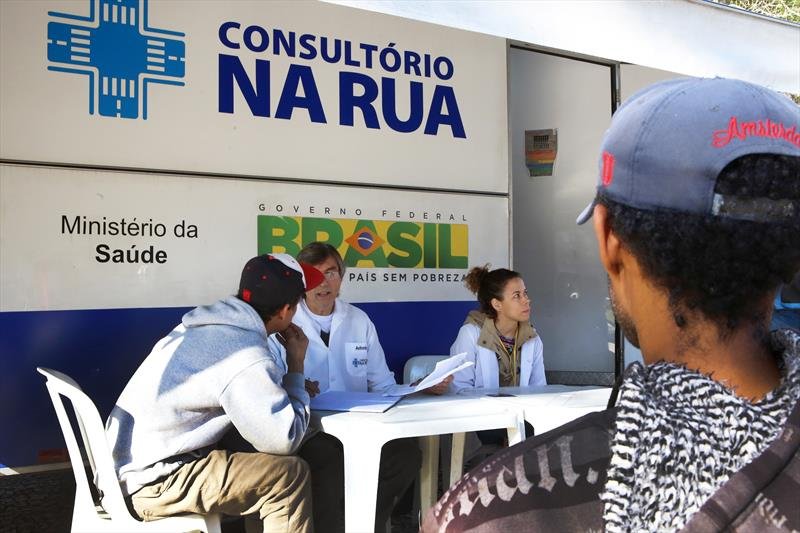
In a strategic move to consolidate equity in Primary Health Care (PHC), the Ministry of Health, in partnership with the Pan American Health Organisation (PAHO), held on Wednesday (21/1), in Brasilia, the Seminar on Good Practices for Equity in PHC - Street Outreach Teams. The event brought together federal, state and municipal managers, as well as frontline workers, to discuss new quality indicators, funding and the implementation of the “Visible Streets” intersectoral plan.
Health as the gateway to citizenship
The event's opening panel emphasised the vital role of the Street Clinic (eCR) teams, not just as providers of medical services, but as agents of social transformation. According to the Assistant Secretary for Primary Health Care, Ilano Barreto, the role of these teams goes beyond technical assistance. “Often, street clinics are almost a beacon for people to feel and realise that they are citizens,” said Barreto.
Lilian Gonçalves, general coordinator of Access and Equity in PHC, emphasised that strengthening these policies is a commitment to human rights and social justice. She emphasised the importance of tripartite coordination (Union, States and Municipalities) so that equity ceases to be a theoretical concept and becomes everyday practice. “Only with tripartite coordination can we achieve the implementation of public policies within the Unified Health System,” Gonçalves argued.
New indicators and funding model
One of the seminar's centrepieces was the presentation of the new scope of indicators that will induce good practices in the eCRs. José Eudes Barroso, director of Family Health, explained that the Ministry is seeking to migrate from a model focused solely on the quantity of registrations to a quality component. “We don't want to discuss the result of the number, but that this is a consequence of the organisation of our care practices,” said Barroso.
The indicators presented focus on four main axes:
- Access: Monitoring of individual, dental and collective appointments.
- Pregnancy Health: Antenatal care, including rapid tests for syphilis, HIV and hepatitis, as well as oral health care.
- STI screening: Annual tests for HIV, syphilis and hepatitis B and C.
- Tuberculosis Control: Focus on regular consultations, sputum smear tests and chest X-rays.
The new funding model foresees an adaptation period in 2026, where all teams will receive the quality component as “good”, with the actual evaluation for payment for performance starting in January 2027.
Integration and technology: The role of SIAPS and e-SUS
Director Audrey Fischer presented the system updates SIAPS and the e-SUS PHC, These are essential tools for managers to be able to identify bottlenecks and actively search for patients. Fischer emphasised the importance of record quality. “The health record is a good practice in itself,” she emphasised, warning of the need to keep systems up to date and make regular backups to avoid losing clinical records.
Visible streets and infrastructure plan
Intersectorality was represented by the partnership with the Ministry of Human Rights and Citizenship through the plan “Visible Streets”,. Cleiton Luiz Rosa, coordinator of the Ministry of Human Rights, pointed out that the phenomenon of the street population is heterogeneous and requires responses that go beyond health, including housing and combating institutional violence.
To support the fieldwork, the Ministry of Health announced robust deliveries for the teams:
- 300 Mobile Units (vans): Adapted vehicles to guarantee travelling and privacy of care.
- Equipment kits: Backpacks containing otoscopes, stethoscopes, sphygmomanometers, sonars and scales for each team.
- Training: A training course in partnership with Fiocruz to train 5,000 professionals and social leaders.
Challenges in the territory
During the debates, municipal managers expressed concerns about the high turnover and mobility of the street population, which makes longitudinal follow-up difficult. Flávio Álvares, representing CONASEMS, emphasised social stigma as one of the biggest barriers: “These are people who suffer from a lot of stigma and various forms of violence,” he said. Afonso Abreu Júnior, from CONASS, added that the street teams were the most powerful expression of the SUS: “It's the SUS that meets people”.
The seminar ended with the promise of a series of 27 state webinars between February and March to resolve technical doubts and improve the methodological notes before the targets are definitively implemented. PAHO's motto, reinforced by Marcos Vinícius Quito, set the final tone for the event: “Leave no-one behind”.