


It was an intense two days at Fiocruz Brasilia (22 and 23 October). Debates, experiences and voices that showed why caring is recognising. Here you'll find a series of exclusive articles on the International Seminar Homeless people: comprehensive care and rights now.
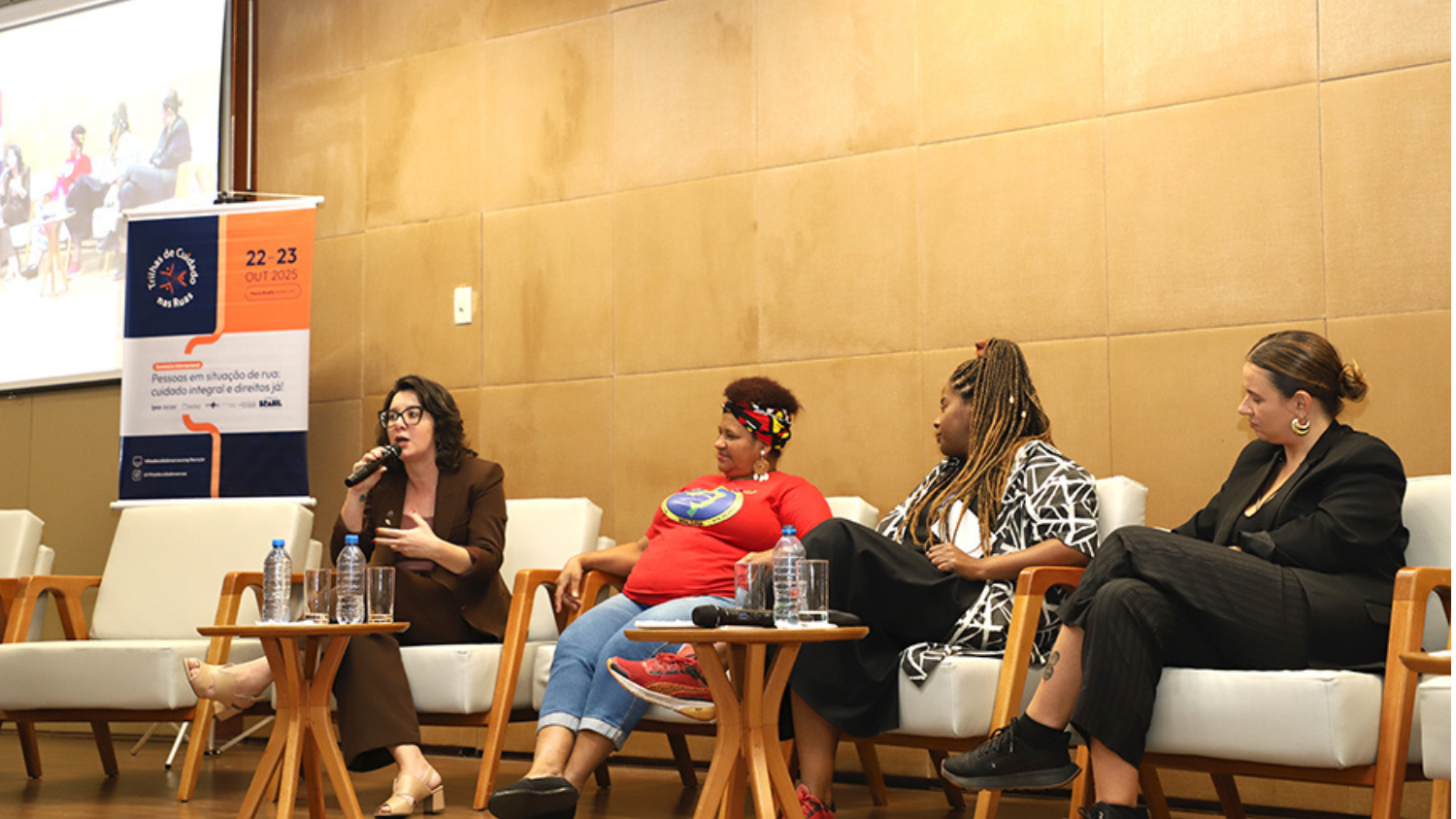
Four leaders took part in the International Seminar on Street People: Comprehensive Care and Rights Now, held at Fiocruz Brasília on 22 and 23 October. Janine Melo (MDHC), Maria Luiza Gama (MDHC), Sheila Costa Marcolino (CIAMP-Rua Nacional) and Laureci (Laura) Dias (CIAMP-Rua Nacional) explained the contradictions, strengths and shortcomings of the Visible Streets Plan. This is the main federal strategy for confronting violence and the reproduction of life on the streets. All the speeches highlighted the same fracture. The policy exists on paper, but is not yet rooted in the materiality of the territories. Its capacity to change the daily lives of those who live on the pavements remains limited by weak federative articulation, low ministerial integration and the effective absence of structuring social participation.
“With the street, not for the street” the official narrative and its limits
Maria Luiza Gama, Director of Policies for Homeless People at the Ministry of Human Rights and Citizenship (MDHC), contextualised the institutional framework that underpins the national policy. She summarised Decree 7.053/2009, Malu emphasised the heterogeneity of the street population, which created CIAMP-Rua, consolidated the national policy and, above all, defined the street population as a heterogeneous group: children, women, people leaving the justice system, LGBTQIA+, the elderly, among others. By reinforcing this heterogeneity, Malu emphasised that there can be no single solution, as different needs require different responses. This premise is the basis of the discourse that her department has been defending, policies “with the street, not for the street”, recognising homeless people as political subjects and not objects of action.
The director explained the situation that led to the emergence of the National Visible Streets Plan (2023). By 2022, less than 1% of municipalities and states had adhered to the national policy. Faced with non-compliance with the constitution, the STF intervened and defined obligations for the federal government, states and municipalities. The Union is responsible for coordinating, monitoring and proposing an action plan; the states and municipalities are responsible for implementing, communicating and prohibiting forced removals. The Plan, structured along seven axes, involves contributions of close to a billion reais. Among its innovations, Malu highlighted the implementation of the Housing First programme under federal coordination, breaking with the historical absence of a specific housing policy on a national scale for this population.
Another strategic point of the speech was the attempt to organise federal governance through Integra PopRua, a questionnaire with more than 80 indicators designed to diagnose municipal capacities and weaknesses. This instrument guides agreements between the federal government and municipalities, making it possible to identify priorities by territory. The map of sign-ups, however, shows a concentration in the Southeast and a low presence in the Centre-West, North and Northeast, which reinforces regional inequalities.
Malu also presented the Cidadania PopRua service, recently implemented in 21 municipalities and the Federal District, with technical teams prepared to deal with cases of rights violations. Finally, she exposed structural problems that prevent the policy from moving forward: the absence of a clear federative flow, insufficient ongoing funding for SUS and SUAS, the lack of permanent housing priorities, the absence of national rules on the seizure of belongings during urban actions, the lack of a decent work policy and the lack of policies to prevent homelessness. The diagnosis is simple, although not at all trivial: without real intersectorality, functional federative agreement and continuous funding, the national policy remains fragile.
Precarious articulation and a timid budget: notes on social control
Councillor Sheila Costa Marcolino, from CIAMP-Rua Nacional, took up the panorama presented by Malu, but gave a critical reading of its implementation. For Sheila, the question asked during the seminar, “what is the effective response to Visible Streets?”, reveals that states and municipalities still don't recognise themselves as co-responsible for implementing the policy. The lack of a solid federal agreement prevents concrete progress.
According to Sheila, when she arrived at CIAMP-Rua, the first version of the plan listed a set of actions that already existed before ADPF 976 (STF), but which had failed to deal with the complexity of life on the streets. The problem is not the existence of these actions, but their incorporation without structural reformulations and without robust guidelines. In addition, the budget is timid in relation to the magnitude of the demands, which limits the impact of the actions.
The counsellor also reported low ministerial participation. Although the plan involves 14 ministries, only a few are consistently present, such as Women, Health and Social Assistance. Other portfolios, particularly Education, have shown difficulty in conceiving actions aimed at the homeless population, which reveals a lack of references and daily commitment.
Sheila pointed out that CIAMP-Rua had presented the federal government with a commented version of the plan, axis by axis, with indications and analyses, seeking greater precision, priority and political coherence. However, the federative gap and inter-ministerial fragility remain central obstacles.
Tax plan, structural exclusions and the defence of street power
The speech by councillor Laureci (Laura) Dias, also from CIAMP-Rua, operated as a counter-narrative, this time from the street and her embodied experience. A black woman, survivor of 20 years of alcohol, crack and cocaine abuse and eight years of abstinence, Laura told how she became a militant, achieved seats in public organisations and took over the coordination of the Women, Gender and Race commission.
Their main criticism is that Visible Streets arrived ready-made, without effective participation, “from the top down”, maintaining the historical logic of delegitimising the knowledge produced by homeless people themselves. The movement accepted the launch only with the agreement that structural changes would be discussed later, a process that is still taking place.
Laura reinforced Sheila's diagnosis: of the 14 ministries mentioned, only three participate effectively. This absence reveals a lack of commitment and reinforces the perception that, for the government, the street population remains an object of action and not a political subject. The counsellor exposed serious omissions in the plan: women, children and adolescents were not included initially. They were only included after intense mobilisation. This exclusion, she said, is unacceptable given the specific nature of the violence faced by women on the streets, such as rape, compulsory removal of children, lack of psychological assistance, cycles of re-victimisation and institutional abandonment.
Another axis of denunciation was the 3% quota for Minha Casa, Minha Vida. Mayors and local managers resist applying the rule, cheat on enrolment and go unpunished. The current penalty, withdrawal of funds, punishes the population, not the manager. That's why Laura demanded exemplary punishments from the federal government and the Public Prosecutor's Office.
The executive secretary of the Ministry of Human Rights and Citizenship, Janine Mello, acknowledged the quality of the dialogue with CIAMP-Rua and highlighted the collegiate body as one of the most qualified instances of social participation in the federal government. She stressed that, after years of institutional blockage, the country is going through a process of rebuilding dialogue. However, the Executive still faces important limitations in coordinating intersectoral policies aimed at the homeless population, especially given the complexity of more than 5,500 municipalities. Janine said that there is already clarity about what needs to be done, but progress has been insufficient in view of the urgency, which is why he defends the reformulation of the Visible Streets Plan with direct validation from CIAMP and listening to the street. She recognised budgetary limits, but reiterated the commitment of the MDHC and partner ministries to adjust the plan and continue to make progress.
Laura also criticised the actions of urban caretakers who confiscate belongings on the grounds of cleanliness. She then called for quotas in public notices, conferences, courses and universities, denouncing the fact that the street population is still excluded even from participatory spaces. She told personal stories to show that going to the streets is often the only way to escape domestic violence. Finally, she reaffirmed the political and human power of the street population, saying that there is life after crack, there is academic training, there is work and there is reconstruction. What is lacking is access to minimum conditions, such as a shower, shelter, clothes and documentation, in order to compete for jobs in the labour market.
The consolidation of the speeches reveals three articulated layers: the institutional framework presented by Malu, which is structured, legally defined, but insufficiently implemented; Sheila's technical-political criticism, which shows a lack of federation and inter-ministerial action, a weak budget and a plan that is not very responsive; and Laura's denunciation, which exposes imposed policies, structural exclusions, daily violence, but also transformative power.
Between the design on paper and real transformation, the chasm is still the street, which is still invisible to part of the state. The three speeches converge in an unequivocal urgency: without the real participation of people living on the streets, functional federal agreements and concrete accountability of managers, the Visible Streets Plan will not become a policy; it will only become a text, it won't get off the ground.
Photo caption: From left to right, Janine Mello, Laureci Dias, Sheila Marcolino and Maria Luiza Gama.