

It was an intense two days (22 and 23 October) at Fiocruz Brasilia - debates, experiences and voices that showed why care is recognition. You can follow a series of exclusive articles about the International Seminar “People living on the streets: comprehensive care and rights now” here.
Held at Fiocruz Brasilia, the “International Seminar on Street People: Comprehensive Care and Rights Now” brought together representatives from ministries, universities, social movements, international organisations and the street population itself on 22 and 23 October. The meeting sought to inspire a new social understanding of life on the streets, recognising the subjectivities, histories and powers of these people and proposing innovative paths of care and social protection.
The opening of the event brought together government, academia and social movements around a common agenda: dignity, intersectorality and comprehensive care
With tables and panels spread over two days, the event debated everything from public policies and social protection to gender and racial equality, maternity, justice and health, highlighting the need for intersectoral and integrated responses. A programme It also included the launch of technical productions, presentations of care experiences and research, as well as the participation of emblematic figures such as Father Julio Lancellotti and representatives of international organisations such as the World Bank and the Alcaldía Mayor de Bogotá.
More than just a space for debate, the seminar consolidated itself as an arena for articulation between the state, academia and civil society, reaffirming the urgency of policies based on human rights and social justice, and promoting the construction of collaborative networks that strengthen belonging, dignity and collective transformation.
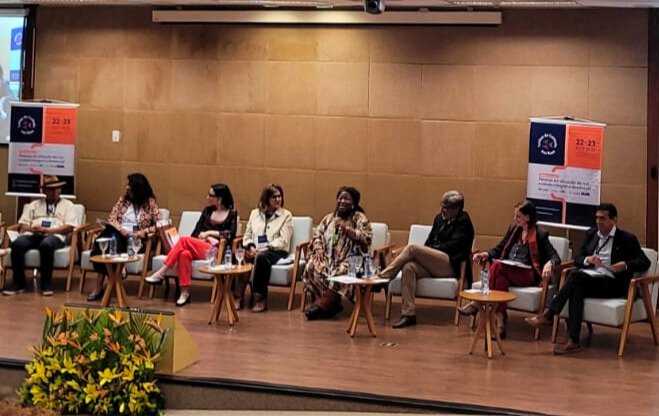
The opening session of the International Seminar “Street People: Comprehensive Care and Rights Now”, held at Fiocruz Brasilia, brought together representatives from the federal government, parliament, research institutions and social movements. In unison, the speakers reaffirmed the same principle: homeless people are subjects of rights, not objects of charity or stigma.
“The street is not a problem, it's a solution”
The general coordinator of CIAMP-Rua Nacional, Anderson Miranda, opened the panel by reminding us that respect begins with recognition. Starting his speech with audio description - a practice aimed at the inclusion of people with visual and hearing impairments - he set the ethical tone for the event: “The street has to be respected and respected too”.
With more than 35 years of experience on the streets, Miranda is now the first representative with direct experience on the streets to be hired by the federal government to work on the national policy for the homeless. Thrilled, he said that the fight is for recognition and for real public policy.
“The homeless population is not a problem, it's a solution. We don't want charity any more, we want continued public policy.”
Miranda defended the creation of a National Secretariat for Policies for Homeless People, with the power to coordinate ministries. He also stressed the importance of dealing with the issue in an intersectoral way, covering housing, health, labour, education and culture. She recalled that CIAMP-Rua is made up of 11 ministries and representatives of civil society, with the task of monitoring, inspecting and engaging in dialogue with states and municipalities.
“We can no longer play the underdog - we are citizens with rights and guarantees.”
“Defending the street is defending democracy”
Federal deputy Ana Pimentel (PT-MG) continued the discussion, emphasising that defending homeless people is also defending life and democracy. She recalled that, after 8 January, Brazil is still facing threats to its institutions and that protecting democracy means protecting the most vulnerable bodies.
“For people living on the streets, there has never been a complete democracy. Defending life on the streets is defending a country that is truly just and in solidarity.”
Ana Pimentel emphasised that effective public policies require real intersectorality and a country project centred on dignity, evoking the driving force of the SUS as inspiration: “We need a country in which everything is for everyone”.
“The right to exist is the first right”
The Minister for Human Rights and Citizenship, Macaé Evaristo, gave a speech with a strong humanitarian and civilising dimension. In an emotional tone, she paid tribute to the activists who resist dehumanisation, pointing out that Brazil still talks first about “street situations” and only then about “people”.
“We have a fight to get out of this tension between those who want to dehumanise us and our fight to bring humanity to the whole population.”
Macaé cited the murder of a trans woman living on the streets in Belo Horizonte the day before as proof that the country still lives with the naturalisation of violence. “We have to stop this mode of production that sucks workers dry and the planet dry,” she said, in direct criticism of the exclusionary logic of contemporary capitalism.
The minister defended the formulation of a Sustainable Development Goal (SDG) of the 2030 Agenda specifically for the Homeless Population, articulated between IPEA and Fiocruz, and concluded by reaffirming the right to decent housing as the central axis of care policies.
“Housing first - everyone has the right to housing and land.”
“There is no development when part of the country is made invisible”
The president of the Institute for Applied Economic Research (IPEA), Luciana Servo, emphasised the importance of science committed to reality. “Politics is done at the grassroots,” she said, recalling her origins in the social movement and her career of more than two decades at IPEA.
She praised the historic cooperation with Fiocruz and the work of the SUS during the pandemic, emphasising that national development can only be thought of in an inclusive and redistributive way.
“How can we talk about development looking at the country only through the rear-view mirror? What would Brazil be without Fiocruz and SUS?”
Luciana highlighted the alarming data on the growth of the homeless population and defended IPEA's role in generating evidence to serve public action and responsibility. In convergence with Macaé, she supported the creation of an SDG 18, transversal to the other Goals of the 2030 Agenda, dedicated to the street population.
“Numbers are not neutral - they are a call to action and responsibility.”
“The right to care, to be cared for and to self-care”
The National Secretary for Care and Family, Laís Abramo, representing Secretary André Quintão, detailed the actions of the Unified Social Assistance System (SUAS) and the recent National Care Policy, sanctioned at the end of 2023.
She stressed that the new law recognises three fundamental dimensions of care - the right to be cared for, the right to care and the right to self-care. In addition, she said that homeless women participated in the formulation of the policy, claiming the right to stay with their children.
“There is no full care when the maternal bond is broken by poverty.”
Laís presented data from the Single RegistryShe also emphasised the fact that 355,000 people have been identified as homeless, of whom 74% receive the Bolsa Família and 7% the BPC. She highlighted the increase from 97% to 99% in the resources allocated to social assistance since the beginning of the current government and defended the constitutional linking of resources to SUAS, guaranteeing continuity and budgetary predictability.
“Intersectorality is the key - no single policy can deal with the street.”
“Working with society is the radical hallmark of this seminar”
The director of the National School of Public Health (ENSP/Fiocruz), Marco Menezes, emphasised the importance of academia being connected to society. “This seminar is a radical example of how we should work: with society and movements,” he said.
He emphasised the role of the Trilhas de Cuidado nas Ruas collective, which includes several Fiocruz units, and the symbolic power of the “Arte no Trecho” exhibition, set up in the event space. Menezes also emphasised the role of public communication as a pillar of social policies.
“Communication is structural in the implementation of public policies.”
Placing the debate in the international context, he recalled that Fiocruz is a Collaborating Centre of the World Health Organisation (WHO/PAHO) and defended a Latin American agenda of human rights and socio-environmental justice.
“Defending the SUS, life and democracy means defending national sovereignty - and no one should be left behind.”
“Producing evidence is producing citizenship”
Representing the director of Fiocruz Brasília, Fabiana Damásio, researcher Gustavo Matta emphasised the global nature of the issue. According to him, one billion people around the world live on the streets or in precarious housing. “The street agenda is global, and Latin America needs to discuss social protection in terms of justice and equity.”
Matta emphasised the role of Nupop/Fiocruz Brasília as a hub for intersectoral policies and research. He mentioned actions such as the Community of Practice in Primary Health Care for PopRua, the Psicoidades project (awarded by PAHO in 2021) and the inter-institutional plan with the Ministry of Justice aimed at training public agents in a humanised approach.
“Intersectorality is not jargon - it is practice, method and commitment.”
For him, scientific production must have a social purpose: “Producing evidence is also producing citizenship. It's giving visibility to the lives that social metabolism tries to erase - black lives, poor lives, disabled lives, lives left on the margins of the city.”
“Evidence needs to transform practices”
Fiocruz researcher and coordinator of the Trails of Care in the Streets project, Elyne Engstrom, closed the panel with a speech that summarised the spirit of the meeting. Thanking the organising team and the participants, she stressed that the seminar was not just an academic event, but a space for ethical and political convergence.
“Evidence is fundamental, but we need to apply it. Involved science must transform practices and change realities.”
Elyne argued that comprehensive care requires articulation between all public policies and overcoming the guilt and charity that still permeate the view of the streets. “We want policies that treat people as subjects of rights, with decent housing, full health and decent work.”
The researcher also pointed out that violence against homeless people remains an open wound: “We still live with murders and massacres, and that's what we want to overcome.”
In closing, he called on the audience to turn the seminar into a starting point for new collective actions and syntheses:
“We don't want this event to blow away. We want it to be consolidated into practices that improve the lives of homeless people.”
A collective pact for dignity
From the voices of those who lived on the streets to those of the institutions that formulate policies and research, the seminar's opening made a common message clear: we need to rebuild Brazil's civilising pact around care, solidarity and social justice.
The challenge, as Elyne Engstrom summarised, is to transform the knowledge and emotion shared during these days into permanent actions of care, dignity and evidence-based public policy.
Read more
Coverage of 22 October 2025
Opening table
- International round table: What kind of world is this? Realities and possibilities of transformation for the social protection of the homeless population
- Panel I : We are not invisible: information for public policies
- Panel II : Homeless women: comprehensive care, maternity and social protection from the perspective of gender and race equality
- Trails invites: Fr Julio Lancellotti
Panel III: The right to social protection and health care in Brazil.
Coverage of 23 October 2025
- Panel IV : Experiences of care I
- Panel V: Experiences of care II
- Panel VI: The role of justice in dealing with homeless people
- Round table: The plan's challenges and potential Visible streets as a public policy strategy - CIAMP/RUA national
Photo caption: From left to right, Anderson Miranda (CIAMPI Rua Nacional); Luciana Servo (IPEA); Ana Pimentel (PT-MG); Elyne Engstrom (ENSP/Fiocruz); Macaé Evaristo (MDHC); Gustavo Matta (Fiocruz Brasília), Laís Abramo (MDS) and Marco Menezes (ENSP/Fiocruz).