


It was an intense two days at Fiocruz Brasilia (22 and 23 October). Debates, experiences and voices that showed why caring is recognising. Here you'll find a series of exclusive articles on the International Seminar Homeless people: comprehensive care and rights now.
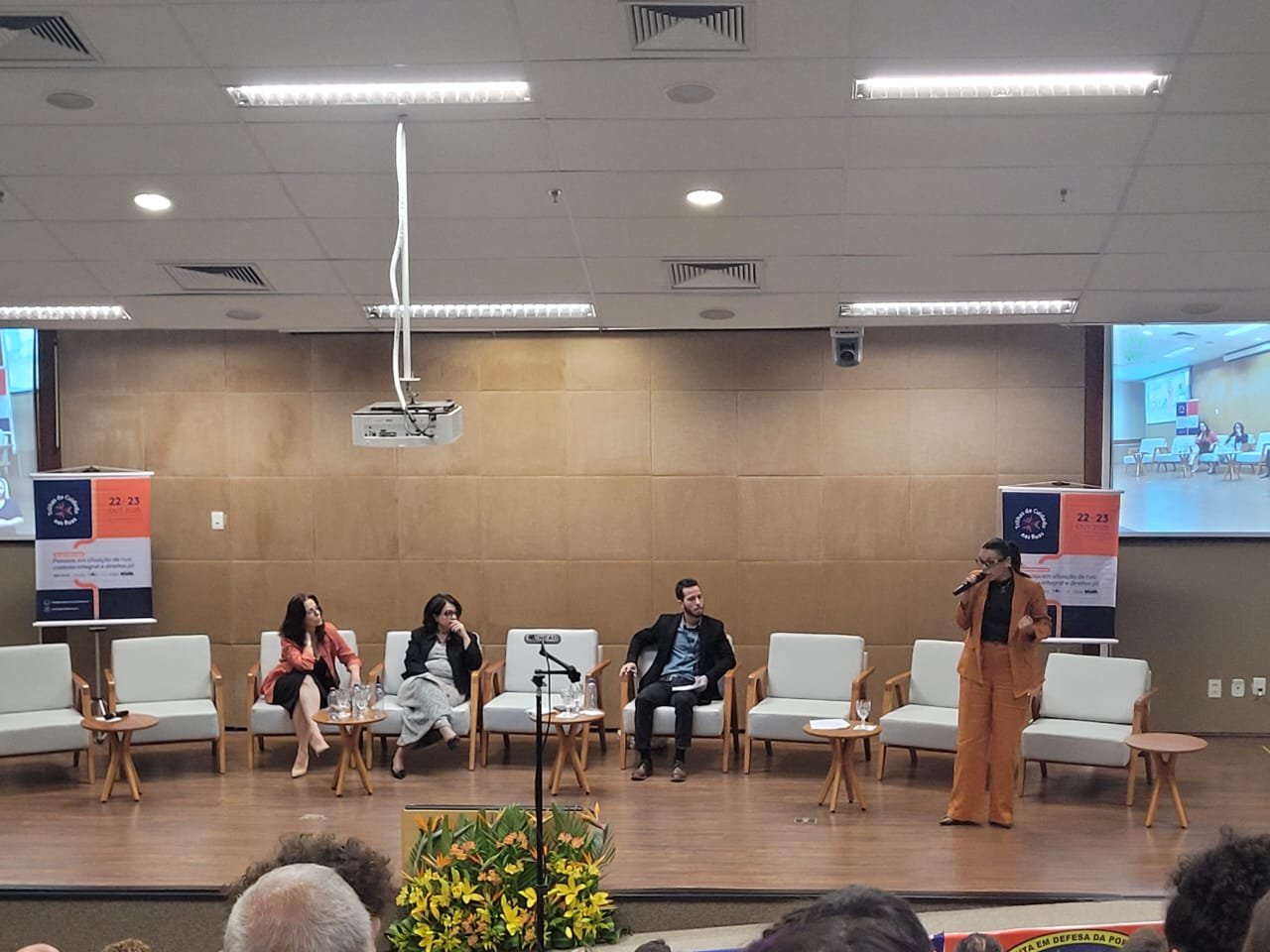
The panel discussion “The role of the judiciary in dealing with the homeless population”, held on 23 October at the International Seminar on Homeless People: Comprehensive Care and Rights Now, The event, held at Fiocruz Brasília, brought together legal professionals and researchers to explain the limits, contradictions and possibilities of the justice system in the face of the chronic violation of fundamental rights. The conversation started from the realisation that the judiciary always arrives too late, when all the other state and social spheres have already failed.
The judiciary as the last line
The panel's mediator, lawyer and researcher Igor Rodrigues, opened the discussion by highlighting the seriousness of the scenario. According to him, when a claim involving the homeless reaches the judiciary, it means that all the previous stages of protection and care have already failed. It is the last trench of citizenship, activated when other mechanisms have not responded.
Rodrigues warned against what he called “judicial redemptionism”, the belief that the judicial system alone could solve the deep social crisis that pushes thousands of people onto the streets. The Action for Non-Compliance with a Fundamental Precept (ADPF) on the homeless population, which was only filed in 2023, was mentioned as an example: although celebrated, it came more than 15 years after a similar initiative in Colombia, which demonstrates the structural slowness of Brazil's institutional reaction.
The researcher also drew attention to the superficial use of the term “multicausal” to describe the phenomenon of homelessness. For him, saying that the problem is multi-causal doesn't explain anything if you don't face its root: the collapse of contemporary capitalism's capacity to include people through work and citizenship. In this context, the homeless population exposes the fissure in the system, as they are not incorporated into the value circuit, becoming disposable.
Rodrigues argued that homelessness is the main mirror of Brazil's social crisis. According to him, the country produces “tsunamis of human waste”, a phenomenon visible in large and small cities, and the street population is the object that connects public failures, lack of alternatives and deepening inequalities.
PopRuaJud and breaking down barriers
Federal judge Luciana Ortiz, coordinator of the CNJ's PopRuaJud Committee, reinforced Rodrigues“ reading, but focussed on the boundaries of the judiciary itself. For her, although the system should not assume the role of the Executive, it cannot omit itself in the face of an ”unconditional state of affairs", an expression used to describe the complete absence of rights for this population.
Ortiz highlighted the concrete obstacles to accessing justice. The lack of civil documentation remains a central barrier: without ID or proof of residence, many homeless people are unable to even physically enter a court. Added to this is the digital exclusion, aggravated by the predominantly virtual functioning of the judiciary. In many cases, he said, people are barred from the doors of courthouses for wearing flip-flops or shorts.
The magistrate presented the CNJ Resolution 425/2021, The law, which instituted the judicial policy for the care of people living on the streets. The rule, drawn up in a collective process with social movements and civil organisations, defined axes of action that include issuing civil documentation, permanent procedural flows, networking and articulated governance in the states.
Ortiz also reported on the progress made in setting up state PopRuaJud committees across the country. For her, networking is essential because judicial provision will never be enough if it is isolated. The issuing of documents during joint efforts is seen as a concrete act of citizenship capable of unlocking access to social benefits, pensions and other rights. Recent cases illustrate the effects of this action, including the granting of welfare benefits with significant retroactive values for homeless people.
The judge cited initiatives to tackle structural issues, such as the influx of people recently released from the penal system, who often migrate directly to the streets for lack of alternatives. She also mentioned the seriousness of institutional actions to take babies away from homeless mothers, a practice that she classified as one of the most impactful and urgent.
Housing as a driver of rights
Giovanna Mello, a prosecutor from the Public Prosecutor's Office, emphasised the centrality of the right to housing as a structuring axis for all other rights. According to her, access to housing is what enables the effective exercise of other guarantees, such as health, education and social protection.
Mello reported cases that reveal the material impossibility of street people complying with health recommendations. Tuberculosis patients, for example, refused treatment because they knew their side effects would be experienced on the streets, without any support, and not because they rejected care.
The prosecutor highlighted the importance of the Public Prosecutor's Office in mediating with housing programmes. She recounted experiences that allowed groups of homeless people to be included in housing programmes, even in the face of the logic of displacement to peripheral regions, historically criticised for breaking territorial ties. More recent solutions, such as the democratisation of federal properties, were pointed out as alternatives to guarantee central housing, close to support networks.
Mello also warned of the risk of this population disconnecting early from the services of the social assistance network once they have access to housing. For her, this phase represents “overcoming the street”, which requires maintaining support. Without this, a return to the streets becomes very likely.
The prosecutor pointed out that the lack of up-to-date national censuses jeopardises the formulation of appropriate policies. At the same time, she emphasised the importance of inspecting facilities for homeless people, pointing out that many of them are overcrowded and often inadequate, especially when they house elderly people who require specific care.
The pandemic period was mentioned as an extreme example of historical neglect. Mello reported how residents were surprised to see homeless people trying to access basic services during the lockdown. At the same time, he drew attention to the speed with which improvisation was deployed when dealing with the pandemic required immediate action, arguing that this agility should become the rule, not the exception.
Name, history and survival
Closing the panel, Judge Raquel Chrispino, from the Rio de Janeiro Court of Justice, brought to the debate the perspective of civil documentation as the basis for exercising all rights. Her presentation was based on more than a decade's experience of issuing documents in vulnerable areas, including working on an itinerant bus dedicated to eradicating under-registration.
Chrispino explained that civil registration is a human right in itself. It accesses essential dimensions: name, filiation, nationality, ancestry and life cycle. Failures in this registration lead to biographical erasure, affecting subjectivity. In many cases, she said, people were registered decades after their birth and cried when they received the document, not because they had access to benefits, but because they were recovering their history.
The judge also detailed the so-called “document chain”. Previously, issuing one document depended on another, creating a bureaucratic maze that perpetuated exclusion. The National Identity Card, she said, simplifies part of this chain by integrating other registers and facilitating access to social rights.
Chrispino also highlighted challenges related to death registration. Homeless people often die without documentation, without a death registration and without the possibility of being mourned by their peers or family members. The judge pointed to this final erasure as a violation of human rights and highlighted decisions that allow bodies to be released to friends who wish to perform funeral rites.
In the end, Chrispino advocated changes in flow and governance capable of making the judiciary more accessible, humane and efficient. For her, networking and tackling under-registration is a minimum condition for guaranteeing access to citizenship.
Read more
Coverage of 22 October 2025
- International round table: What kind of world is this? Realities and possibilities of transformation for the social protection of the homeless population
- Panel I : We are not invisible: information for public policies
- Panel II : Homeless women: comprehensive care, maternity and social protection from the perspective of gender and race equality
- Trails invites: Fr Julio Lancellotti
- Panel III:
The right to social protection and health care in Brazil.
Coverage of 23 October 2025
- Panel IV : Experiences of care I
- Panel V: Experiences of care II
- Panel VI: The role of justice in dealing with homeless people
- Round table: The plan's challenges and potential Visible streets as a public policy strategy - CIAMP/RUA national
Photo caption: From left to right, Raquel Chrispino; Luciana Ortiz; Igor Rodrigues and Giovana Mello .