

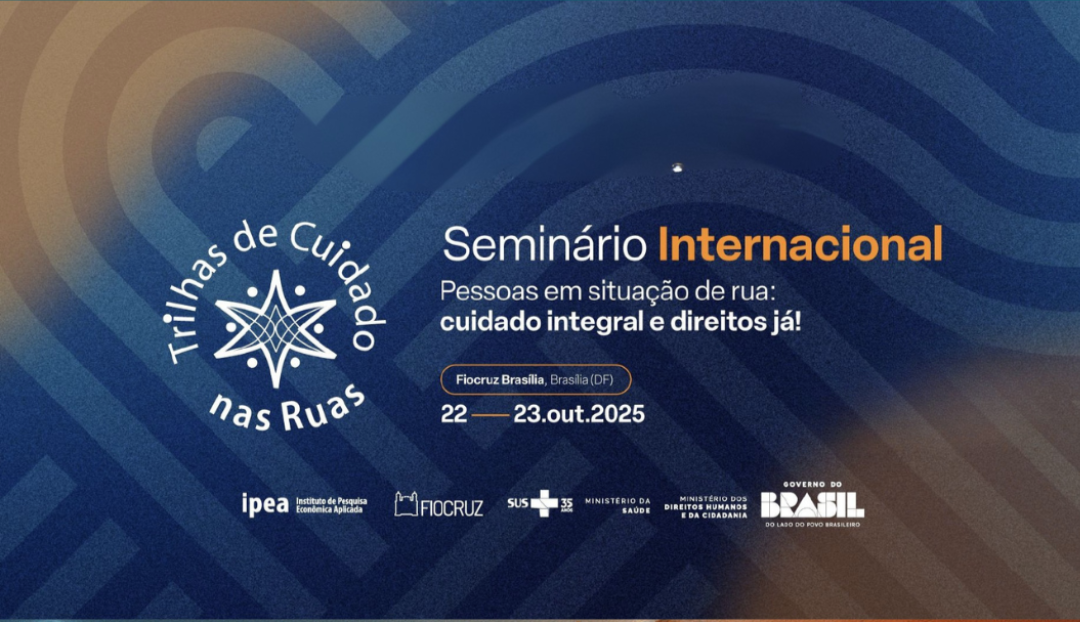

It was an intense two days at Fiocruz Brasilia (22 and 23 October). Debates, experiences and voices that showed why caring is recognising. Here you'll find a series of exclusive articles on the International Seminar Homeless people: comprehensive care and rights now.
The morning of the second day of International Seminar on Homeless People: Comprehensive Care and Rights Now! (23/10), held at Fiocruz Brasilia, was dedicated to reporting on successful national and international experiences.
The district secretary for Social Integration at Bogotá City Hall, Roberto C. Angulo, pointed out that the extreme exclusion of the homeless population in the Colombian capital is marked by an average of 12.6 years living in this condition, with 20% starting life on the streets as children, highlighting deep flaws in social protection systems.
When presenting the Bogotá strategy, Roberto Angulo said that the situation of people living on the streets reflects a picture of “extreme exclusion”, going beyond poverty and requiring integrated responses. His central thesis is that street dwelling is the result of a critical accumulation of social, economic and participation deprivations, reinforced by events such as family violence, substance abuse and failures in the social protection system.
Among the main arguments, Angulo highlighted: (1) street dwelling as a chronic phenomenon-an average of 12.6 years on the streets; (2) an early start to the trajectory of exclusion, since 1 in 5 people entered the streets under the age of 18; (3) permanence conditioned by problematic consumption of psychoactive substances; (4) low access to rights and opportunities-only 5.6% have higher education, 46% live by recycling; (5) discrimination and fragile support networks, with only 14% receiving institutional help. Data from the 2024 census also reveals that 5% reported attempting suicide in the previous month.
For Angulo, “street living is the result of many years of failed social agreements”.
By implication, Bogotá is betting on five integrated fronts: statistical visibility, diversified housing solutions (including models inspired by Brazil), territorial health care, specific services for ageing and integration for social, productive and community inclusion. Counterpoint: the manager recognises the lack of robust prevention policies, especially in relation to substance use.
World Bank - Integrated models for getting off the streets
Paula Correa, a consultant at the World Bank, presented a comparative analysis of policies for dealing with homeless people in high- and middle-income countries, with an emphasis on the “Housing First” model. The central thesis is that housing solutions articulated with support services and prevention strategies produce sustainable and cost-effective results.
Among the main arguments were the diversity of housing arrangements according to the profile of homeless people and the fiscal efficiency of investing in permanent housing by reducing the demand for emergency services. Correa also stressed the need for individualised management, intersectoral coordination between housing, health and care, and the importance of prevention as a cross-cutting axis - from social rent policies to measures against evictions.
The expert cited Finland as evidence of success: since 2008, the country has reduced its homeless population by 78% by adopting a combination of housing subsidies, prevention and co-operative governance. “A policy is only sustainable when housing and services go hand in hand,” she said.
As a practical implication, he suggested the creation of integrated housing and social protection systems in Brazil, guided by data and shared governance models.
Gaps mentioned: average costs per beneficiary and monitoring mechanisms have not yet been detailed.
Experiences and social movements show that access to housing, comprehensive care and shared governance are central pillars for facing the challenge of PopRua in Brazil and Latin America.
Housing - Comprehensive care with bonding and autonomy
Coordinator Ravena Lima presented the experience of the Assisted Housing project in Salvador, a municipal initiative inspired by the Housing First model and adapted to the reality of the local street population. The central thesis defended is that ensuring housing and integrated support is a condition for rebuilding autonomy and family and community ties.
Among the main points, Lima highlighted the role of the social movement in the origin of the policy, which began in partnership with the National Movement of the Homeless Population in 2020; the adaptation to the territorial context of Salvador; monitoring by multi-professional teams and the construction of shared life plans; and harm reduction as a guiding principle. It also emphasised investing in bonds and trust as part of care.
Data from the pilot (2023-2025) shows that of the 20 families assisted, 15 remained until the end, with an average of 58 home visits per centre. All the children were included in the school system, and five families achieved formal employment. “Talking about the offer of a house is much more than just the house,” he said.
The experience points to the need for policies that make assisted housing programmes permanent, expanding the use of public resources and partnerships with civil society organisations.
Training - Collaboratory strengthens participatory management
Marcelo Pedra, a representative of the Trilhas de Cuidado nas Ruas collective and Fiocruz Brasília, presented the PopRua National Collaboratory, created in 2023 in co-operation with the Ministry of Human Rights, public universities and the National Street People's Movement. The project aims to consolidate management, training and participatory research environments aimed at qualifying policies for the street population.
According to Pedra, the collaboratory is structured in 14 decentralised hubs - from Manaus to Porto Alegre - each with teams made up of technical coordinators and people with a street background. The initiative articulates joint actions between SUS, SUAS and rights defence institutions, training operators and public leaders.
The PopRua National School, the project's training arm, carried out activities in all the participating capitals, offering training workshops and drawing up methodological booklets on participatory management. As a concrete product, the teams drew up an intersectoral guide that standardises service flows between health and care for pregnant women, drug users and vulnerable families.
Between March 2023 and September 2025, the collaboratory promoted 920 activities, reaching 30,131 people - 13.5% of them homeless. “It's a project made up of many hands, with the population as the subject and not just the public,” said Pedra.
The model proves the importance of institutionalising shared management networks and the focus on harm reduction.
Network - Catalogue maps care practices in the country
Closing the panel, Professor Mirna Teixeira, from ENSP/Fiocruz and the Trilhas de Cuidado nas Ruas Collective, launched the National Catalogue of Intersectoral Experiences of Care for the Street Population - an initiative that seeks to map and disseminate practices in health, assistance, housing and income generation developed throughout Brazil.
The catalogue, Teixeira explained, was born out of the need to connect dispersed experiences and give visibility to innovative work carried out by municipalities, universities, collectives and civil organisations. The methodology used key informants and data collection via an electronic form, with criteria based on innovation, sustainability, social impact and the adoption of low-demand approaches.
“We want to show that there is a lot of good being done that can be replicated,” he said. The inaugural catalogue brings together 22 experiences - six in integral health, four in housing, two in education and training, two in social protection and eight in network articulation - including Salvador's Assisted Housing and the PopRua National Collaboratory.
The proposal is to keep the material in digital format, with free access and continuous updating, allowing for the incorporation of new experiences and the formation of a collaborative network that already includes Fiocruz, USP, IPEA and PAHO. Each project is described with objectives, results and lessons learnt, followed by an authorial analysis of the collective.
“The idea is to do together what would not be possible on our own,” said Teixeira, stressing that the catalogue is intended to be a tool for ongoing education and an empirical basis for integrated public policies.
All the presentations at the International Seminar on the Homeless emphasised that the fight against social exclusion requires intersectoral policies based on the right to housing, comprehensive care and participatory governance. The principle is that the street is not a destiny, but an expression of cumulative inequalities that can be reversed through public investment, social recognition and the protagonism of homeless people themselves.